You’re sharp. Capable. Driven. People rely on you. And yet…
You constantly feel behind.
You miss appointments, forget names, lose track of tasks you swore you’d remember. You rewrite the same to-do list every morning because yesterday’s priorities evaporated the moment you opened your inbox.
You bounce between hyper-focus and brain fog. Some days, you’re in flow and on fire. Other days, you can’t finish a thought.
You’ve built a successful career—yet part of you fears you’re one dropped ball away from being exposed.
If this sounds familiar, I want to offer a possibility you might not have considered:
What if the root of your struggle isn’t laziness, disorganization, or burnout?
What if it’s ADHD?
The Leadership Cost of Unseen ADHD
When most people think about ADHD, they picture a hyperactive child who can’t sit still in school.
They don’t picture a high-performing executive, a startup founder, or a seasoned team leader.
But the truth is, ADHD doesn’t discriminate by age or success level. And in adults—especially high-functioning women—it often hides in plain sight.
ADHD is a neurological condition that affects executive functioning. In leadership terms, it’s not a matter of capability—it’s a matter of cognitive regulation.
Leaders with undiagnosed ADHD often struggle with:
- Sustaining attention during meetings or strategic planning
- Following through on goals without external pressure
- Prioritizing effectively when everything feels urgent
- Emotional regulation—especially when stakes are high
- Time management and estimation
- Avoiding impulsive decisions or tangents
- Feeling internally organized and grounded
On the surface, these might look like typical “stress symptoms.” But for many leaders, they’re long-standing patterns that no amount of productivity hacks can fix.
Why You May Not Know You Have It
Here’s the kicker: most adults with ADHD don’t know they have it.
In fact, research suggests that up to 75% of adults with ADHD remain undiagnosed. And this source suggests that 20% of c-suite leaders have undiagnosed ADHD.
Women, in particular, are often missed because they’re more likely to experience the inattentive symptoms—daydreaming, forgetfulness, mental fatigue—rather than visible hyperactivity.
For many, ADHD gets masked by overachievement, perfectionism, or people-pleasing. You’ve likely spent years (decades?) building workarounds. Creating elaborate systems. Micromanaging your calendar. Burning out and bouncing back.
And when those systems start to break down—especially in midlife—it feels like you are the problem.
You’re not.
You’ve been operating with a wiring difference. You just didn’t have a name for it.
Vertical Development Meets Neurodivergence
In my work with leaders, I help them understand two sides of personal development:
- The Doing Side—skills, behaviors, knowledge
- The Being Side—how your internal operating system is wired
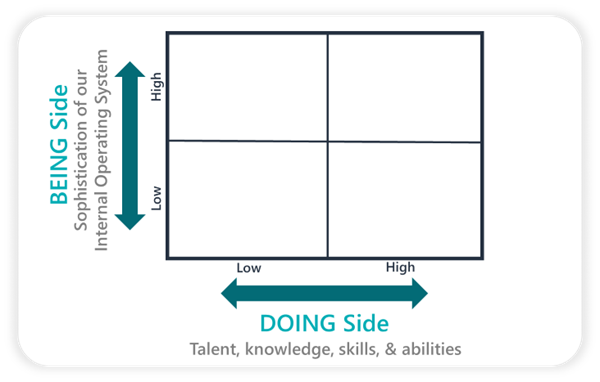
Most leadership development focuses on the Doing Side: better habits, time-blocking, frameworks. And those matter.
ADHD is a Being Side issue. It affects your brain’s core regulatory systems. It makes it harder to pause between stimulus and response. It narrows your window of tolerance. It limits your ability to plan, prioritize, and execute consistently—not because you don’t want to, but because your brain is fighting its own chemistry.
And that’s not a character flaw. It’s a neurological one.
But here’s the good news: you can upgrade your operating system.
What You Can Do If You Suspect ADHD
You don’t have to self-diagnose or jump to conclusions. But if any of this resonates, take these steps:
1. Give Yourself Permission to Be Curious
Start with compassion, not judgment. You’re not trying to “label” yourself. You’re exploring a new lens that might finally make sense of years of struggle.
2. Watch This TED Talk or Read This Book
Learn more about what it is like to discover how ADHD impacts people through this fantastic TEDx Talk by Kristen Pressner: Why Is It That So Many People Just “Can’t Get It Together?”
Her journey of awakening to ADHD within her family is deeply relatable and beautifully human. It might just mirror things you’ve never put into words before.
Or, if you want to sink your teeth into a book, pick up Becoming Better: The Groundbreaking Science of Personal Transformation. In it, you’ll learn about my wife’s experience of learning that she has ADHD and what she has done to transform and elevate herself.
3. Look for These 7 Executive Function Signs
These are the core areas often impacted by ADHD:
- Reduced self-awareness (running on autopilot, reacting instead of responding)
- Struggles with impulse control (blurting out, multitasking ineffectively)
- Weakened working memory (forgetting what you’re doing mid-task)
- Time blindness (missing deadlines, poor planning)
- Emotional reactivity (difficulty regulating frustration or disappointment)
- Low self-motivation (especially for repetitive or non-stimulating tasks)
- Disorganization/problem-solving issues (difficulty mapping out next steps or processes)
If multiple of these sound familiar—it’s worth paying attention.
4. Consider Getting Tested
ADHD isn’t something to be ashamed of. In fact, a diagnosis can be liberating. It explains patterns you’ve long tried to willpower your way out of—and opens the door to meaningful support.
5. Know That There Is a Way Forward
From neurofeedback and coaching to mindfulness and trauma-informed therapy, there are powerful tools available to help rewire your internal operating system. In fact, many leaders I’ve worked with describe this process as the beginning of real transformation.
You’re Not Broken—You’re Wired Differently
There’s a quote I return to often:
“You can’t heal what you can’t feel.” — Edith Eger
I’d add:
“You can’t upgrade what you don’t first understand.”
If you’ve been operating in high gear but still feel like something is “off”…
If your systems are breaking down and your self-talk is getting cruel…
If you’ve ever thought, “Maybe I’m just not cut out for this anymore…”
Take a breath.
Then take the next small step.
The Next Step
If you resonated with this post—if it sparked a quiet “This might be me”—then my new book, Becoming Better, was written with you in mind.
In it, I dive deeper into how ADHD affects our internal operating system—what I call our Being Side—and how it can quietly shape our leadership, relationships, and self-perception. More importantly, I offer a pathway forward: how to understand your wiring, upgrade your internal system, and lead with greater clarity, composure, and connection.
Whether you’ve been diagnosed, suspect you might have ADHD, or are simply seeking to lead from a higher altitude, Becoming Better will help you move from self-protection to value creation—from surviving to truly thriving.
👉 Learn more and get your copy here: Becoming Better: The Groundbreaking Science of Personal Transformation.