
We all hit walls. It might show up in our work, our relationships, our health, or our sense of purpose. Things slow down. Energy dips. Progress stalls. That’s stagnation — and while it can feel discouraging, it may be one of the most important signals in your personal development journey.
What Is Stagnation?
Stagnation occurs when your growth, learning, or momentum slows or stops altogether. It often feels like being “stuck” — not necessarily in crisis, but lacking a sense of forward movement.
And here’s the truth: stagnation is inevitable.
Life moves in seasons. We push forward in some areas and, at the same time, stall out in others. The goal isn’t to avoid stagnation altogether — it’s to recognize it for what it is and learn how to work with it.
In my personal experience and in studying this phenomenon with others, I’ve learned four key lessons about stagnation:
- Stagnation sucks. It drains vitality. It makes us feel like we’ve hit a ceiling. And over time, it can chip away at our hope in the possibility of a brighter future.
- But stagnation often precedes transformation. When we learn to leverage it as a “heat experience” — something that challenges and stretches us — it can be the very catalyst for breakthrough.
- Most people feel stagnant but can’t articulate why. They sense the symptoms but rarely grasp the deeper drivers beneath the surface.
- Without understanding the root causes, people remain stuck. They may try new habits or external changes, but if they’re not addressing the underlying dynamics, they struggle to create meaningful and lasting growth.
So how do we better understand and move beyond stagnation?
Introducing the Stagnation Tree Model
To make sense of stagnation — and more importantly, to overcome it — we need a framework that gets below the surface. That’s where the Stagnation Tree Model comes in.
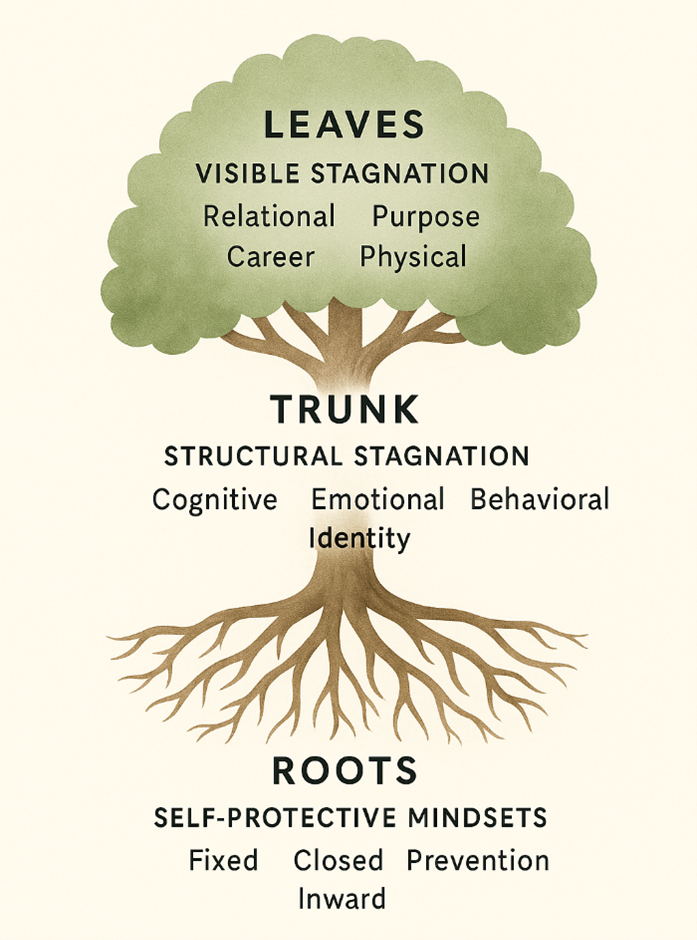
This model helps us move from what we feel to what’s actually driving our experience. It breaks stagnation into three levels:
Leaves: Visible Stagnation
This is the surface layer — where stagnation shows up in your everyday life. Most people can easily identify if they are stagnant in these areas:
- Relational Stagnation (Occurs when an individual’s personal and professional relationships plateau, with little growth in trust, depth, or openness.)
- Career Stagnation (Occurs when an individual plateaus in professional growth, ambition, or achievement.)
- Purpose Stagnation (Occurs when an individual disconnects from a clear sense of purpose, values, or meaning in their life and work.)
Physical Stagnation (Occurs when an individual’s routines limit growth in physical health, vitality, or energy.)
These are the “leaves” of the tree — visible, tangible, and familiar. But they’re just the starting point.
Trunk: Structural Stagnation
This is where things get more revealing. Structural stagnation refers to the internal patterns that feed into the visible issues above. It includes:
- Cognitive Stagnation (Occurs when an individual plateaus in learning, thinking, or problem-solving, showing little growth in depth, agility, or openness to new ideas.)
- Emotional Stagnation (Occurs when an individual becomes stuck in habitual emotional patterns without growing emotional awareness, resilience, or maturity.)
- Behavioral Stagnation (Occurs when an individual gets locked into routines or habits that no longer support their growth or goals)
- Identity Stagnation (Occurs when an individual fails to evolve their self-concept, worldview, or role identity over time.)
Unless we identify the structural dynamics at play, any surface-level change will be short-lived.
Roots: Self-Protective Mindsets
At the base of it all lie your mindsets — deep-seated, often subconscious ways of seeing and navigating the world. These are usually formed to protect you from perceived threats, but over time they become limiting:
- Fixed – The degree to which you see yourself as someone who can’t really change, and the degree to which you fear failing or looking bad.
- Closed – The degree to which you think that what you know is best, and the degree to which you fear being wrong or not being in control.
- Prevention – The degree to which you seek to ensure your personal safety and comfort, and the degree to which you fear having problems.
- Inward – The degree to which you tend to see others as objects (as opposed to as people), and the degree to which you fear falling behind.
These self-protective mindsets silently shape everything above them. They feed the trunk, which then shows up in the leaves. And until they’re identified and challenged, the cycle of stagnation continues — even if you’re working hard at the surface level.
Why This Matters
When you can diagnose where and why you’re stagnant, you unlock the ability to change — not just temporarily, but fundamentally. You stop wasting energy pruning leaves and start addressing the roots.
If you’re currently feeling stuck in any area of your life, take heart. Stagnation is not the end — it’s an invitation. It’s your system’s way of telling you that something deeper is ready to be seen, understood, and transformed.
And if you’re ready to explore that deeper work — whether for yourself or your team — I’d be honored to support you on the journey.
👉 Feel free to connect with me if you’d like help working through stagnation (at either an individual or team level) and stepping into your next level of growth.