
I recently surveyed my newsletter subscribers to learn about their experiences with stagnation. I received 89 responses.
I asked questions related to individual-level stagnation, which I will report on in this blog post. And, I asked questions about team-level stagnation, which I will report on in the next blog post.
Why I Ran This Survey
I’ve experienced stagnation to different degrees and at different times. As I reflect on these experiences with stagnation, I can now see that the most difficult, challenging, and frustrating experiences of my life came about because I was experiencing some form of stagnation.
When we fail at something, experience frustrating conflict, have a relationship blow up, feel burned out, find ourselves stuck, or aren’t reaching our potential, a foundational reason why is because some aspect of ourselves is stagnant.
I have come into this believing that if I can better understand others’ experiences with stagnation, I believe I can help them so that they don’t have to experience the same level of difficulty and frustration that I have.
Specifically, in putting together this survey, I wanted to learn the following:
- How common is stagnation?
- How commonly do people experience a meaningful amount of stagnation?
- What forms of stagnation do most people struggle with?
- Can they identify why they are experiencing their stagnation?
- Do they know how to get out of stagnation?
I want to walk you through the answers that I got for each of these questions.
How Common is Stagnation?
Across the 89 people, 76% of them state that they regularly experience stagnation (meaning that they indicated they experience stagnation either occasionally, frequently, or very frequently).
And, 54% indicated that they are currently experiencing stagnation in their personal or professional life.
Houston, we have a problem.
How Commonly do People Experience a Meaningful Amount of Stagnation?
The reality is that at any given time, some facets of ourselves and our life are going to be stagnant. We can’t progress in all facets at all times. Given this, I wanted to know how big a problem stagnation is for people.
I found that 84% of people who are currently experiencing stagnation are experiencing stagnation that is at least moderately significant. This means that 45% of the total respondents are experiencing at least a moderate amount of stagnation.
Specifically, of the people currently experiencing stagnation:
- 43% of people state that their stagnation is moderately limiting their growth and effectiveness
- 37% of people state that their stagnation is very significantly limiting their growth and effectiveness
- 4% of people state that their stagnation is extremely significantly limiting their growth and effectiveness
What Forms of Stagnation Do Most People Struggle With?
Here is what I found:
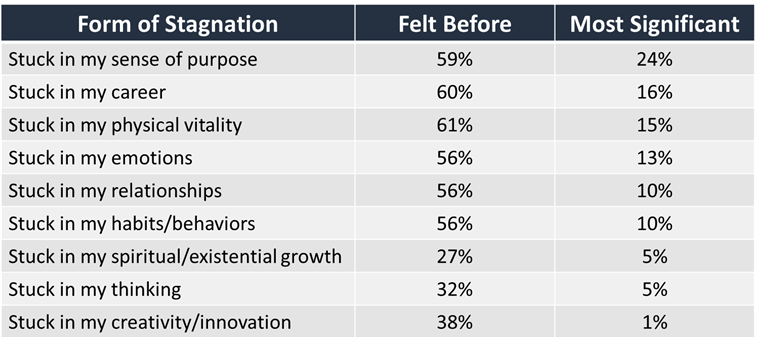
This reveals that:
- People can feel stuck in different ways
- People feel more stuck in some ways than other ways
The form of stagnation that seems to have the most significant impact on people is a feeling of being stuck in their sense of purpose.
Can They Identify Why They are Experiencing Their Stagnation?
Here is what I found:
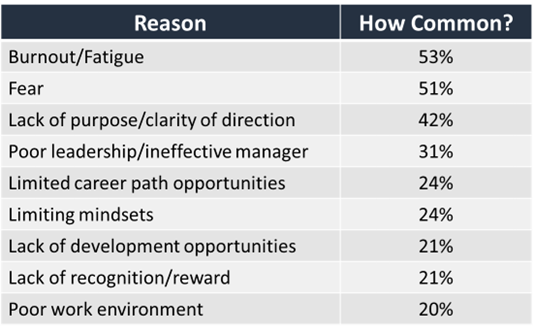
To me, this suggests that people can struggle with stagnation because of factors related to their environment and factors related to themselves.
Also, if we recognize that self-protective mindsets are at the root of almost all of our fears, this reveals that my vertical development and mindset programs are ideal to address stagnation.
Do They Know How to Get Out of Stagnation?
The short answer is: “Not really”
Only 24% of people feel confident that they know how to get out of stagnation.
Summary
Stagnation is a common and significant problem. Yet, few people know how to get out of it.
If you are feeling stagnant, or even just want to explore facets of your life where stagnation may be creeping in, start by taking my new and FREE Personal Stagnation Assessment.
Here is a visual for the framework for this assessment:
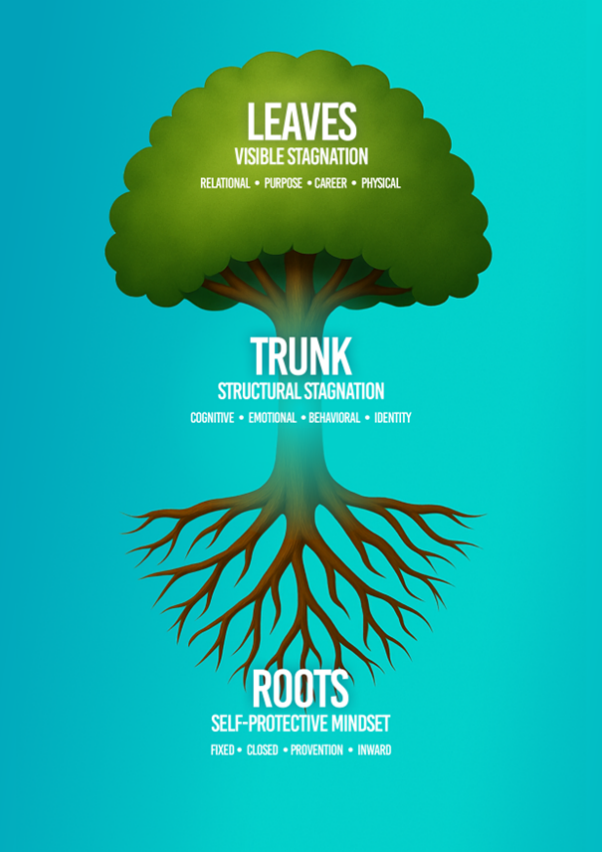
I think most people can recognize when they are experiencing one of the forms of visual stagnation, but they generally have a hard time connecting into the structural stagnation and self-protective mindsets driving the visual stagnation. Yet, those are the levels that need to be addressed to get unstuck.
If you want to explore coaching or other programming to get out of your stagnation, connect with me. I want to help you get unstuck and blast into a more elevated version of yourself.