



I recently surveyed my newsletter subscribers to learn about their experiences with stagnation. I received 89 responses.
I asked questions related to individual-level stagnation, which I reported on previously. And, I asked questions about team-level stagnation, which I will report on here.
Why I Ran This Survey
I’ve experienced stagnation to different degrees and at different times. As I reflect on these experiences with stagnation, I can now see that the most difficult, challenging, and frustrating experiences of my life came about because I was experiencing some form of stagnation.
When we fail at something, experience frustrating conflict, have a relationship blow up, feel burned out, find ourselves stuck, or aren’t reaching our potential, a foundational reason why is because some aspect of ourselves is stagnant.
I have come into this believing that if I can better understand others’ experiences with stagnation, I can help them so that they don’t have to experience the same level of difficulty and frustration that I have.
Specifically, in putting together this survey, I wanted to learn the following:
- How common is team stagnation?
- How commonly do people experience a meaningful amount of team stagnation?
- What forms of team stagnation do most people struggle with?
- Can they identify why they are experiencing their team stagnation?
- Do they know how to get out of team stagnation?
I want to walk you through the answers that I got to each of these questions.
How Common is Team Stagnation?
Across the 89 people, 82% of them state that they regularly experience team stagnation (meaning that they indicated they experience team stagnation either occasionally, frequently, or very frequently).
And, 43% indicated that they are currently experiencing team stagnation in their professional life.
Not what I wanted to see, but it doesn’t surprise me given that the success and effectiveness rates of teams is generally quite low.
How Commonly do People Experience a Meaningful Amount of Team Stagnation?
I found that 83% of people who are currently experiencing team stagnation are experiencing stagnation that is at least moderately significant. This means that 36% of the total respondents are experiencing at least a moderate amount of team stagnation.
Specifically, of the people currently experiencing stagnation:
- 33% of people state that their team stagnation is moderately limiting the team’s growth and effectiveness
- 42% of people state that their team stagnation is very significantly limiting the team’s growth and effectiveness
- 8% of people state that their team stagnation is extremely significantly limiting the team’s growth and effectiveness
What Forms of Team Stagnation Do Most People Struggle With?
Here is what I found:
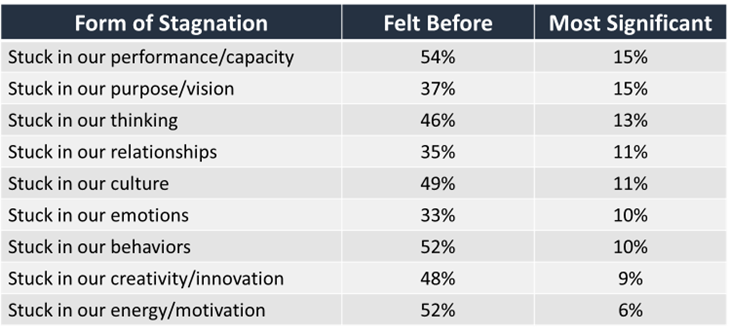
This reveals that:
- Teams can feel stuck in different ways
- Teams feel more stuck in some ways than other ways
It doesn’t surprise me that a good proportion of people pointed to performance stagnation as being common and significant. This is because performance stagnation is very surface-level. As such, it is the most tangible. But, it is generally the result of deeper layers of stagnation.
I find it interesting that only 37% percent of respondents have experienced purpose stagnation (I expected it to be higher). But, the respondents seem to indicate that if they are feeling purpose stagnation, it feels quite significant.
Can They Identify Why They are Experiencing Their Team Stagnation?
Here is what I found:
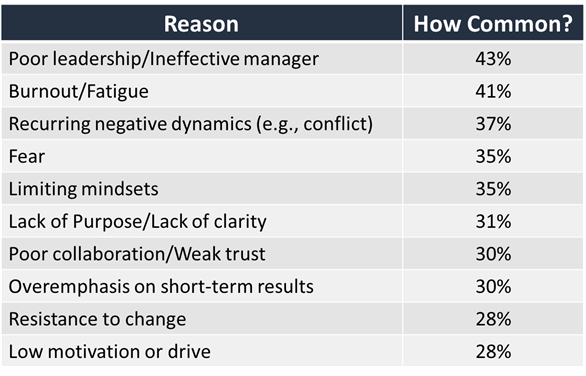
I wondered where poor leadership would show up. And, it shows up right at the top, and is probably the reason for some of the other factors below: burnout, negative dynamics, fear, lack of purpose, poor collaboration. But, surely the blame can’t always or squarely go on the leader.
I just think that most leaders do not think that they are playing a meaningful role in any type of team stagnation.
Do They Know How to Get Out of Team Stagnation?
The short answer is: “Not really”
Only 20% of people feel confident that they know how to get out of team stagnation.
Summary
Team stagnation is a common and significant problem. Yet, few people know how to get out of it.
If you are on a team experiencing stagnation, or if you are supporting teams experiencing stagnation, I have developed a new program to help.
This program involves taking a Team Stagnation Assessment to determine what forms of stagnation the team is experiencing.
Here is a visual for the framework for this assessment:
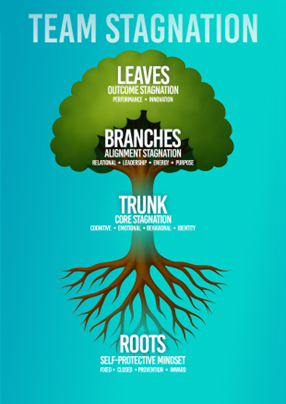
Once we identify the forms of stagnation that the team is struggling with, we will (1) report back to the team, and (2) develop a customized approach to help the team get unstuck, focusing on forms of stagnation they are struggling with.
If you want to explore this with a team you are connected to, let’s chat.









2 Responses
This is cutting edge research. The hard part will be uncovering a methodology for reducing the stagnation.
This is cutting edge research. The hard part will be uncovering a methodology for reducing the stagnation.