Let’s do a quick check-in.
- As a leader, are you being asked to do more with less?
- Are you being asked to go faster, even though you already feel maxed out?
- Does it feel like your world is getting increasingly complex?
If so, you’re not alone. In fact, you’re normal.
But let’s face it—normal isn’t going to cut it anymore. And you don’t want normal.
You want a way to rise above the pressure, create real traction, and lead with more clarity and less strain.
Here’s the hard truth: the solution probably isn’t making your world easier or less complex. I’m not sure that’s realistic.
Which leaves one viable path: you need to level up in your leadership operating mode.
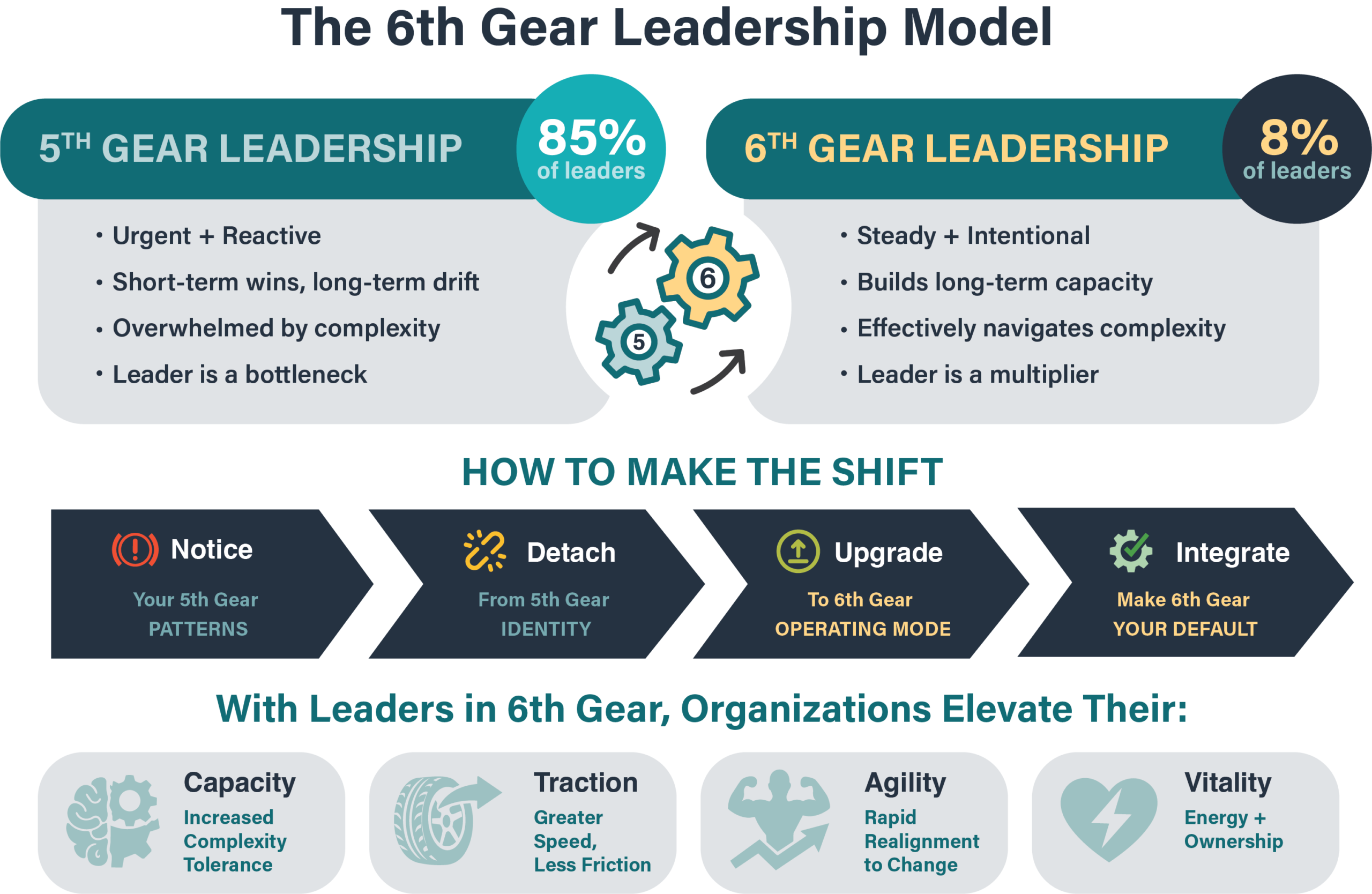
You need to shift from 5th Gear Leadership—where you can go fast but at a cost—to 6th Gear Leadership, where you can go faster with less friction.
Let me define what I mean.
6th Gear Leadership—defined
6th Gear Leadership is the highest gear of leadership—shifting out of urgency and control into clarity, trust, and long-term capacity.
When leaders operate in 6th gear, they don’t just perform better—they raise the ceiling of the groups and systems they lead, creating transformational impact in a complex world.
That’s the definition I want you to hold.
Because 6th gear is not a mood.
It’s not “being calm.”
It’s not a personality trait.
And it’s definitely not “soft leadership.”
It’s an upgraded operating mode.
The promise: Higher speed. Lower RPMs.
Here’s the simplest way to understand what 6th gear delivers:
You go faster with less strain.
In a car, you can go fast in 5th gear—but you’ll be running at higher RPMs. More heat. More friction. More wear. More breakdown.
6th gear is different.
You’re still moving fast—often faster—but the system isn’t grinding to do it.
That’s exactly what happens when an executive team shifts into 6th gear:
- decisions get cleaner
- execution gets smoother
- conflict becomes more productive
- accountability becomes more natural
- the culture becomes healthier
- and the leader stops being the bottleneck
Not because expectations drop—
but because the operating mode rises.
Why 6th gear is rare
If 6th Gear Leadership is so powerful, why don’t we see it more often?
Because most leaders have been rewarded for 5th-gear performance.
They’ve been promoted for:
- driving hard
- producing outcomes
- moving fast
- solving problems
- taking control
- pushing through resistance
And again, those aren’t bad things.
But they train the nervous system to believe:
“When stakes rise, I must speed up and tighten control.”
That’s the 5th-gear reflex.
And in a complex environment, that reflex generates drag.
6th gear requires a different kind of strength:
- steadiness instead of urgency
- trust instead of control
- curiosity instead of defensiveness
- long-term value creation instead of short-term chasing
This is why 6th gear feels like a maturity upgrade.
Because it is.
5th gear vs 6th gear (the practical contrast)
Here’s what 6th gear looks like in contrast to 5th gear.
5th Gear Leadership
- Urgent + reactive
- Leads with control
- Short-term wins, long-term drift
- Overwhelmed by complexity
- Leader becomes the bottleneck
6th Gear Leadership
- Steady + intentional
- Leads with trust
- Builds long-term capacity
- Creates clarity in complexity
- Leader becomes a multiplier
If you’re a senior leader reading this, you can probably recognize both gears—not just in yourself, but in your organization.
And you’ve likely seen this pattern:
When the environment gets more complex, the system tries to go faster… by revving higher.
But that approach breaks down.
Because speed without clarity is just motion.
What changes when leaders shift into 6th gear
When leaders operate in 6th gear, it changes what they optimize for.
Instead of optimizing for:
- control
- certainty
- rapid outcomes
- self-protection
- short-term performance
They begin optimizing for:
- clarity
- value creation
- sustainable execution
- trust and ownership
- long-term capacity
And that changes everything.
Not because leaders stop caring about results, but because they stop trying to force results through urgency.
In 6th gear, leaders create conditions where results come with less friction.
6th gear is a developmental achievement, not a motivational moment
This is important:
6th gear is not something you “decide” to do one day.
It’s not a slogan you adopt.
It’s not a mindset quote you put on a slide.
It’s a developmental upgrade.
It requires that leaders:
- see their default patterns clearly
- loosen their identity grip (the need to control, prove, protect)
- build capacity to hold tension without reactivity
- anchor in a deeper, value-creating purpose
- and practice new ways of leading until they become the default
In other words:
6th gear isn’t about being inspired.
It’s about being upgraded.
A quick self-check
To make this real, consider two questions:
- When pressure rises, do I speed up and tighten control—or do I slow down and create clarity?
- Does my leadership create more dependence—or more ownership?
Those questions are a mirror.
They reveal your current gear.
And the good news is: once you can see your 5th Gear tendencies, you open the door to shift to 6th Gear.
If you want to learn how you can shift into 6th Gear, to go faster at lower RPMs, let’s connect.