You may be getting results as a leader, but the real question is: What gear are those results coming from?
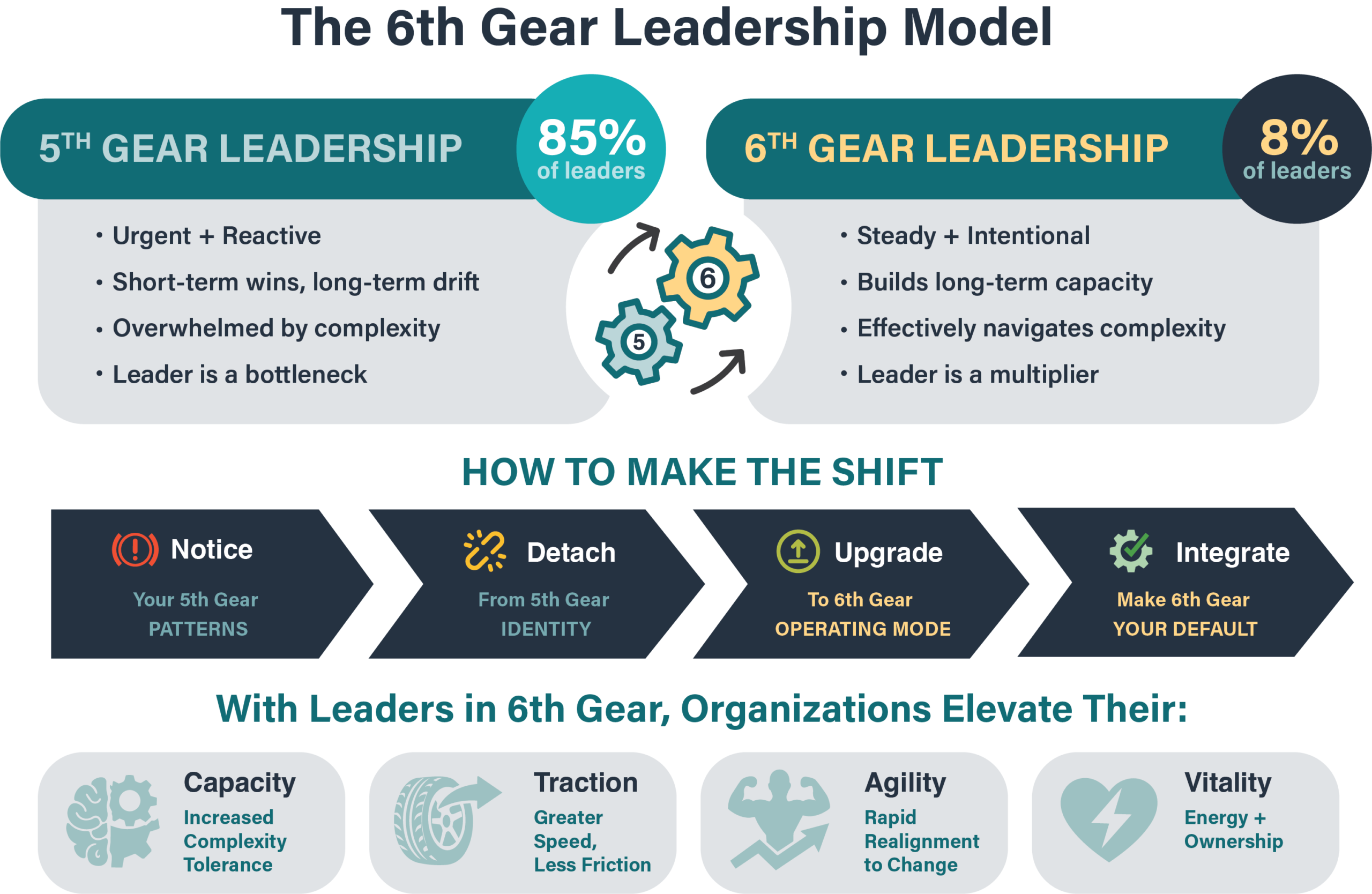
Most leaders operate in 5th Gear. They move fast, push hard, and stay in control. They get things done through intensity, urgency, and effort. And yes, that can work—but it often creates friction, dependence, and burnout along the way.
Few leaders operate in 6th Gear. They are just as effective—often more so—but they lead differently. They create momentum through clarity, trust, and alignment. They do not rely on pushing harder; they reduce the drag that slows everyone down.
That is the difference: 5th Gear creates speed through force. 6th Gear creates speed with less friction.
Most senior leaders can access both. The challenge is that when pressure rises (which is the norm for most leaders), many instinctively drop into 5th Gear.
That is why the key question is not simply, Am I a strong leader? It is: What gear do I lead from most often—especially when it matters most?
Default Gear vs Stress Gear
Default gear is how you lead when things are relatively stable:
- You have space to think
- You’re not feeling cornered
- The environment is manageable
Stress gear is how you lead when stakes rise:
- Time compresses
- Uncertainty increases
- Consequences feel higher
- Your nervous system starts optimizing for safety, certainty, and control
Most leaders don’t notice the shift because it happens quickly.
But your team feels it immediately.
Why this matters at the executive level
At senior levels, your gear doesn’t just affect you.
It affects the entire system.
If your stress gear is urgent and controlling, people:
- escalate more
- take fewer risks
- prioritize optics over truth
- optimize for short-term wins
- wait for your approval before moving
If your stress gear is steady and trust-based, people:
- take ownership
- solve problems without drama
- surface issues sooner
- make cleaner decisions
- sustain performance with less burnout
This is why your gear sets the ceiling.
The 6th Gear Self-Check (10 questions)
You can use this as a quick diagnosis today. Answer honestly using this scale:
1 = rarely
2 = occasionally
3 = about half the time
4 = often
5 = almost always
Part A: Your 5th Gear signals (urgency/control)
- When pressure rises, I speed up and push for rapid action.
- I become more controlling (tighter oversight, more checking, more directing).
- I prioritize short-term wins even when they create long-term drift.
- I feel responsible to “carry it” and become the bottleneck for decisions or progress.
- When tension rises, I become more reactive (impatient, frustrated, or defensive).
Score A (add 1–5): ____ / 25
Part B: Your 6th Gear signals (clarity/trust/capacity)
- Under pressure, I can slow down enough to create clarity.
- I lead with trust, creating ownership rather than dependence.
- I stay anchored in purpose and long-term value creation even when urgency is loud.
- When tension rises, I approach it with curiosity rather than reactivity.
- I help the team navigate complexity without oversimplifying or forcing premature certainty.
Score B (add 6–10): ____ / 25
Interpreting Your Results (simple and useful)
If Score A is higher than Score B:
Your stress gear is likely 5th gear.
That means your leadership is probably generating traction through urgency and control—but paying a “friction tax” in complexity.
Common signs:
- you carry too much
- the team escalates too quickly
- urgency feels constant
- alignment takes longer than it should
- culture starts to tighten under pressure
If Score B is higher than Score A:
You’re more consistently accessing 6th gear under pressure.
That means you’re leading complexity with steadiness and trust, and your leadership likely multiplies the organization’s capacity.
Common signs:
- ownership is high
- conflict becomes productive rather than toxic
- decision-making is cleaner
- execution has less rework
- leaders below you grow rather than depend
If your scores are close:
This is extremely common for senior leaders.
It usually means you can access 6th gear—but pressure still pulls you into 5th gear in predictable moments.
That’s actually good news.
Because the path forward isn’t “become a different person.”
It’s to become more aware of:
- what triggers the downshift
- what identity is driving it
- what 5th gear looks like in that moment
- what practices help you integrate 6th gear as the default
The most valuable question: What pulls you into 5th gear?
If you want the fastest insight from this post, answer this:
When I downshift into 5th gear, what am I trying to protect or control?
For most senior leaders, it’s something like:
- avoiding failure
- protecting credibility
- preventing chaos
- staying ahead
- proving competence
- maintaining certainty
These drivers aren’t “bad.”
They’re often protective strategies that once served you.
But in complexity, they can become the very thing that limits your leadership impact.
If you want help shifting into 6th Gear, let’s connect.