
In the first article in this series, I introduced the idea of Leadership Capability Level.
Leadership Capability Level is the degree to which a leader has developed the internal capacities and leadership capabilities required to lead people, teams, groups, and organizations in ways that bring out the best in others and make results sustainable—not merely how successful, talented, experienced, or technically capable the leader is.
This distinction matters because organizations often evaluate leaders by asking, “Can they deliver results?” But results alone do not tell us whether a leader is capable of building people, trust, clarity, culture, ownership, and systems that make results sustainable.
A leader may produce strong results in the short term while leaving behind dependency, burnout, fear, confusion, or cultural damage.
That is why we need a better way to evaluate leaders.
One helpful way to do this is with a simple 2×2.
The Leadership Capability 2×2
The horizontal axis is Results Delivery: the degree to which a leader can execute, perform, and produce desired outcomes.
The vertical axis is Leadership Capability Level: the degree to which a leader has developed the internal capacities and leadership capabilities required to bring out the best in others and build the people, teams, culture, and systems that make results sustainable.
Together, these two dimensions create four types of leaders:
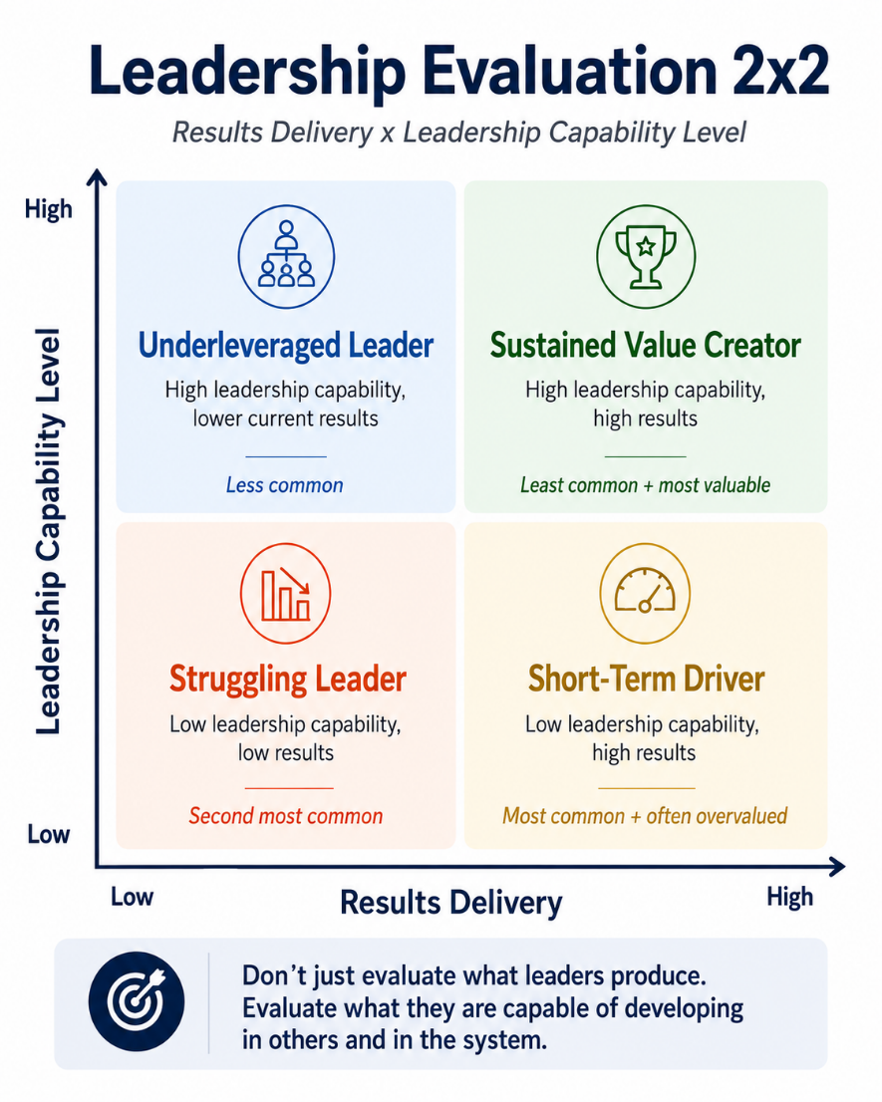
This 2×2 helps reveal why leadership evaluation often goes wrong. Organizations are usually good at noticing whether someone is delivering results. They are often less disciplined about evaluating how those results are being produced and whether the leader is building long-term capability around them.
That is why the upper-right quadrant matters so much.
The best leaders are not merely high performers. They are high-capability builders.
1. The Struggling Leader
Low Results Delivery / Low Leadership Capability Level
The Struggling Leader is low in both results delivery and Leadership Capability Level.
This leader is not consistently producing the desired outcomes, and they are not yet capable of leading others in ways that bring out their best and make results sustainable. They may lack clarity, self-awareness, emotional regulation, confidence, discipline, people-leadership skill, or the ability to create alignment and accountability.
Often, these leaders become hidden in the organization. This is because they generally operate at a level where they keep things afloat, and they and their teams do not stand out in any way when it comes to performance or results.
In many organizations, this is the second most common leadership profile.
The key question with a Struggling Leader is: Is this a development issue, a support issue, a role-fit issue, or a readiness issue?
Some Struggling Leaders can improve significantly with coaching, structure, feedback, and support. Others may be in roles that exceed their current capability level or do not fit their strengths.
2. The Short-Term Driver
High Results Delivery / Low Leadership Capability Level
The Short-Term Driver is high in results delivery but low in Leadership Capability Level.
This is the most common—and often the most overvalued—leadership profile.
These leaders get results. They hit the number. They complete the project. They solve the problem. They push things forward. Because of that, they are often praised, promoted, protected, and held up as examples.
Let’s be honest, organization’s incentive systems are largely designed to produce Short-Term Drivers.
But the way they produce results may create long-term costs.
They may rely on control, urgency, charisma, technical expertise, intimidation, over-involvement, or personal force of will. They may be highly capable as individual performers or technical experts, but not yet capable of building the capability of others. They may move fast, but leave people depleted. They may win, but create dependency.
Public life gives us many examples of this pattern. Some famous sports coaches have won championships while also becoming known for anger, intimidation, or damaged relationships. Some founders have built extraordinary companies while also creating cultures that became serious liabilities. Some brilliant executives have driven innovation while making the organization overly dependent on their personal intensity, control, or genius.
The point is not to label any individual leader as simply “bad” or “incapable.” The point is that strong results can mask leadership limitations.
That is what makes the Short-Term Driver so dangerous.
Their results are visible. Their costs are often delayed.
People may say:
“Yes, they are hard to work with, but they get results.”
Or:
“Yes, people burn out under them, but they know how to win.”
Or:
“Yes, the team depends on them for everything, but they always come through.”
Those statements reveal the problem. The leader may be delivering results, but they are not necessarily building capability.
The key question with a Short-Term Driver is: Are this leader’s results creating long-term capability—or long-term dependency?
3. The Underleveraged Leader
Low Results Delivery / High Leadership Capability Level
The Underleveraged Leader is high in Leadership Capability Level but lower in results delivery.
This leader may be self-aware, grounded, humble, empowering, relationally strong, and committed to developing others. They may build trust, create psychological safety, and care deeply about people and culture.
But they are not yet producing the results the role requires.
This profile is less common, but important. Underleveraged Leaders often have a strong leadership foundation, but they may need help translating that foundation into execution, influence, strategic clarity, business acumen, decisiveness, or organizational leverage.
In some cases, these leaders are overlooked because they are not the loudest, most forceful, or most visibly heroic leaders. They may not create the impression of constant urgency. They may not dominate the room. They may not appear as “driven” as the Short-Term Driver.
But their foundation may be stronger.
The key question with an Underleveraged Leader is: What is preventing this leader’s capability from translating into stronger results?
These leaders are worth investing in because their leadership capability foundation is already present. They may need better role fit, clearer expectations, stronger execution systems, or coaching around strategic influence.
4. The Sustained Value Creator
High Results Delivery / High Leadership Capability Level
The Sustained Value Creator is high in both results delivery and Leadership Capability Level.
This is the least common and most valuable leadership profile.
These leaders deliver results, but not by making everything dependent on themselves. They build people, teams, culture, and systems that make results more sustainable.
- They create clarity.
- They build trust.
- They empower ownership.
- They develop others.
- They uphold standards.
- They navigate conflict constructively.
- They help people adapt to change.
- They think systemically.
- They protect what matters most.
Their performance is not merely a reflection of their own talent. It is a reflection of the capability they build around them.
This is what makes Sustained Value Creators so valuable. They do not just win today. They increase the organization’s ability to win tomorrow.
Think of leaders who are admired not only because of what they achieved, but because of what they built in others. Coaches like Tony Dungy are often discussed this way: not merely as winners, but as leaders known for composure, character, development, and culture. In business, leaders like Alan Mulally are often held up not only for results, but for creating alignment, transparency, and a healthier operating system around the work.
Again, no leader is perfect. But the pattern is important.
Sustained Value Creators produce results while also building the conditions that allow results to continue.
The key question with a Sustained Value Creator is: How can we learn from, support, incentivize, and multiply this kind of leadership?
Why Organizations Overvalue Short-Term Drivers
The 2×2 reveals a major leadership evaluation problem:
Organizations often overvalue Short-Term Drivers because their results are easy to see, while the costs of their low Leadership Capability Level are easier to ignore.
Results show up in dashboards, scorecards, revenue numbers, project completion, growth metrics, and wins.
But low Leadership Capability Level often shows up more slowly. It appears in burnout, disengagement, turnover, silence, politics, dependency, weak bench strength, poor succession, unresolved conflict, and cultural erosion.
By the time those costs become obvious, the Short-Term Driver may have already been promoted, rewarded, or used as the model for others to follow.
This is how organizations unintentionally teach leaders that results matter more than capability, control matters more than empowerment, urgency matters more than sustainability, and winning matters more than building long-term capacity.
The Leadership Evaluation Shift
The purpose of this 2×2 is not to minimize results.
Results matter.
But results should not be the only thing we evaluate.
If we want better leaders, stronger teams, healthier cultures, and more sustainable performance, we need to evaluate both:
Can this leader deliver results?
And:
Is this leader truly capable of leading others in ways that bring out their best and make results sustainable?
The most valuable leaders are not merely those who get results.
They are those who get results while developing the capacity for more people, teams, and systems to succeed over time.
In the next two articles, we will look at the 12 dimensions of Leadership Capability Level, beginning with six signals of leaders who can develop themselves and others.
What’s Coming Next in This Series
This article is the second in a six-part series on Leadership Capability Level. In the next four articles, we will continue exploring how to better evaluate whether leaders are truly capable of building the people, teams, culture, and systems required for sustainable success.
Article 3: Six Signals of a Leader Who Can Develop Self and Others
We will explore the first six dimensions of Leadership Capability Level: Self-Development, Self-Awareness, Emotional Regulation and Non-Reactivity, Empowerment vs. Control, Developing Others, and Relational Attunement and Psychological Safety.
Article 4: Six Signals of a Leader Who Can Develop Teams and Systems
We will explore the second six dimensions of Leadership Capability Level: Purpose, Clarity, and Culture; Accountability and Standards; Conflict Capacity; Adaptability and Change Leadership; Strategic Discipline; and Systems Thinking.
Article 5: How to Assess Leadership Capability Level
We will turn these 12 dimensions into practical evaluation questions that leaders, teams, and organizations can use for self-reflection, coaching, development planning, promotion conversations, and succession planning.
Article 6: How to Elevate Leadership Capability Level
We will explore how leaders can actually elevate their Leadership Capability Level by moving beyond Doing Side development—skills, tools, and techniques—and focusing on Being Side development: the deeper work of upgrading the internal operating system from which they lead.
Ready to Evaluate What Your Leaders Are Truly Capable of Building?
Don’t just evaluate what your leaders produce. Evaluate what they are capable of developing in others and in the system.
If you want help assessing and elevating your leaders’ Leadership Capability Level, let’s connect.