
A CEO I once coached had built a successful business and was very good at what she did. She had become so good, in fact, that every client proposal eventually came through her for final approval. Sometimes she was weighing in on something as small as the title.
There was a good reason for this. When she got involved, the proposal often got better. The company won work. Her involvement produced results.
But it was also creating dependence. Her team was learning that important work was not really finished until she had touched it. What looked like strong performance in the present was quietly creating a problem for the future.
This is one of the reasons I have become increasingly interested in trajectory when I think about leadership.
An organization can be performing reasonably well today while becoming less capable of succeeding tomorrow. Another may be struggling today while developing stronger leaders and healthier conditions that position it well for the future.
Current performance matters. But trajectory tells us something different.
That is what I am trying to better understand through Leadership Health.
I define Leadership Health through three factors: Results Delivery, Leadership Capability, and Leadership Environment. What I have found particularly useful is looking at the relationships among those three factors.
Results Delivery × Leadership Capability
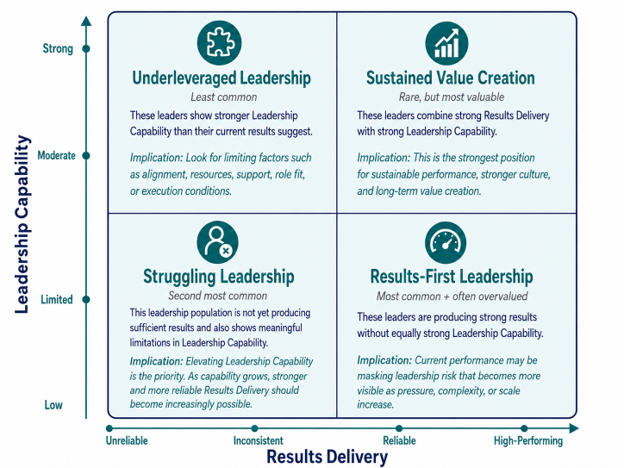
The most common pattern I see is also one of the most difficult to deal with: Results-First Leadership.
These leaders are producing. The numbers may look good enough that there is no obvious reason to intervene. In many organizations, these are the leaders being praised and promoted.
The problem is that their Results Delivery is stronger than their Leadership Capability.
This is where the CEO I described earlier fits. She could get results, but too much of the organization’s success still depended on her personally. Every time she stepped in and improved the work, she reinforced the belief that the work needed her.
This is why Results-First Leadership is so tricky. The current results may be positive while the trajectory is flat or negative.
As pressure, complexity, or scale increase, weaknesses that were previously masked by strong execution can become much more visible.
Leadership Capability × Leadership Environment
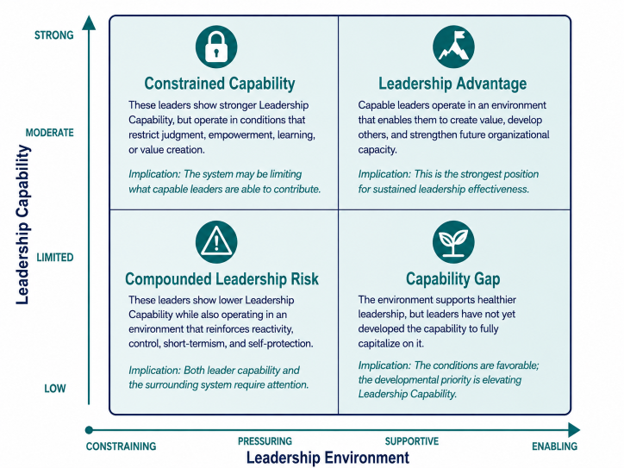
When we compare Leadership Capability with Leadership Environment, the pattern I see most often is Compounded Leadership Risk.
This means two things are happening at the same time.
Leaders do not yet possess the level of Leadership Capability the organization needs, and they are operating in an environment that reinforces urgency, control, short-term thinking, and self-protection.
This can create a difficult negative spiral.
Lower-capability leaders are more vulnerable to pressure from the environment. When expectations rise, they are more likely to become reactive, take control, protect themselves, or focus narrowly on immediate outcomes.
But the environment that pulls those behaviors out of them can also make it harder for them to grow beyond them.
If people are constantly overloaded, heavily punished for mistakes, rewarded mainly for short-term results, or expected to personally solve every problem, it becomes much harder to create the reflection, experimentation, and developmental space required to elevate Leadership Capability.
This is why changing only one side of the equation is often insufficient. Developing leaders while leaving the environment untouched may not stick. Changing the environment without helping leaders grow may not produce the leadership the organization needs.
Results Delivery × Leadership Environment
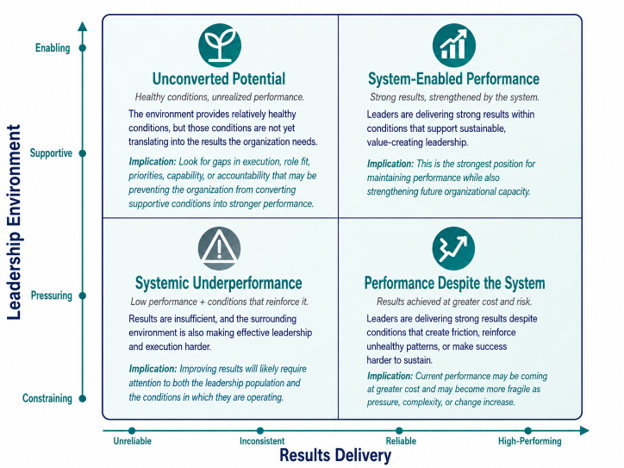
The third relationship looks at Results Delivery and Leadership Environment.
Here, the pattern I encounter most often is Performance Despite the System.
The organization is getting results, but leaders are producing them within conditions that make those results harder and more costly to sustain.
Maybe leaders are carrying unreasonable workloads. Perhaps priorities keep changing. Decisions get escalated unnecessarily. Incentives encourage behavior that works against stated values. Or leaders simply have to work around organizational friction to get anything done.
Because the numbers are still acceptable, these conditions can persist for a long time.
That is what makes this quadrant dangerous.
The fact that leaders are overcoming the system does not mean the system is healthy.
Again, current performance can look better than trajectory.
What the Three Relationships Tell Us
When I put these three views together, a pattern becomes hard to ignore.
Most organizations are not in an obvious leadership crisis. Their results are often good enough to keep things moving.
But beneath those results, Leadership Capability may not be keeping pace with the demands leaders face. The Leadership Environment may be pulling leaders toward less effective ways of operating. Or both may be happening at once.
In other words, an organization’s current performance may be stronger than its trajectory.
There is good news, neutral news, and bad news in that.
The good news is that trajectory can change.
The more neutral news is that changing it requires looking at all three elements of Leadership Health. Most organizations already know how to focus on Results Delivery. They know how to set goals, track metrics, evaluate performance, and hold people accountable.
The more difficult news is that the organizations that most need to change their trajectory often have much less clarity about how to elevate Leadership Capability or improve Leadership Environment.
Yet those two factors are frequently where the deeper work resides and is needed.
If you want a light diagnostic of where your leadership currently stands, I have developed a FREE Leadership Health Scan that looks across Results Delivery, Leadership Capability, and Leadership Environment. It takes 5-7 minutes to complete.
And if you want to go deeper—especially if you suspect your current results may be masking a less healthy trajectory—reach out to me. I also work with organizations to conduct deeper Leadership Health diagnostics and identify where the greatest opportunities for improvement reside.