Across this series, I have argued that organizations need to move beyond evaluating leaders only by asking, “Can they deliver results?”
Results matter. But results alone do not tell us whether a leader is capable of building the people, team, culture, and systems required for sustained success.
That is why we also need to evaluate a leader’s Leadership Capability Level.
Leadership Capability Level is the degree to which a leader has developed the internal capacities and leadership capabilities required to lead people, teams, groups, and organizations in ways that bring out the best in others and make results sustainable—not merely how successful, talented, experienced, or technically capable they are.
In the previous article, I shared a simple way to assess Leadership Capability Level across 12 dimensions.
But assessment is only the beginning.
Once leaders identify where their Leadership Capability Level needs to be elevated, the next question is: How do they actually elevate it?
The answer is not simply more tools, techniques, or training.
The answer is deeper development.
Why Traditional Leadership Development Often Falls Short
When leaders struggle, organizations often respond by giving them more tools.
- If leaders struggle with feedback, we teach them a feedback model.
- If they struggle with delegation, we teach them a delegation framework.
- If they struggle with conflict, we teach them a difficult-conversations script.
- If they struggle with change, we teach them a change-management model.
These tools can be helpful. But they are rarely sufficient.
Why?
Because most leadership struggles are not merely skill issues. They are capability issues rooted in deeper development issues.
- A leader may know how to delegate and still micromanage because they feel anxious about losing control.
- A leader may know how to give feedback and still avoid hard conversations because they fear disapproval.
- A leader may know the importance of developing others and still fail to make time for it because they are overidentified with being productive, needed, or indispensable.
- A leader may know how to lead change and still become reactive because uncertainty threatens their sense of competence, control, or security.
This is why traditional leadership development often underdelivers. It focuses heavily on what leaders need to do, while giving too little attention to who leaders need to become.
Doing Side vs. Being Side Development
To elevate Leadership Capability Level, we need to distinguish between two different kinds of development: Doing Side development and Being Side development.
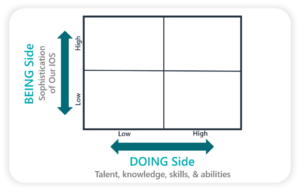
Doing Side development, often called horizontal development, focuses on adding knowledge, skills, tools, techniques, and competencies. It helps leaders do more.
Being Side development, often called vertical development, focuses on upgrading the internal operating system from which leaders operate. It helps leaders become more capable, more self-aware, more emotionally regulated, more secure, more purpose-centered, and more able to lead from value creation rather than self-protection.
Doing Side development is important. Leaders need tools. They need skills. They need frameworks.
But Doing Side development alone cannot fully elevate Leadership Capability Level because the 12 dimensions of Leadership Capability Level (first 6, second 6) are rooted in how leaders see, interpret, regulate, relate, and respond.
Doing Side development helps leaders expand what they can do.
Being Side development helps leaders elevate who they are being while they lead.
That is the deeper work.
Why the 12 Dimensions Require Being Side Development
Consider the 12 dimensions of Leadership Capability Level.
Each dimension has visible behaviors, but underneath those behaviors are deeper Being Side roots.
Dimension |
Surface Issue |
Deeper Being Side Issue |
| Self-Development | “I do not have time to grow.” | Overidentification with productivity, achievement, or being needed. |
| Self-Awareness | “I do not see my impact.” | Defensiveness, ego protection, or low openness to feedback. |
| Emotional Regulation | “I react under pressure.” | Low tolerance for discomfort, threat sensitivity, or nervous system dysregulation. |
| Purpose, Clarity, and Culture | “Firefighting.” | Lack of internal clarity, courage, or discipline to repeatedly reinforce what matters. |
| Empowerment vs. Control | “I micromanage.” | Anxiety about trust, failure, image, or losing control. |
| Developing Others | “I do not make time to coach.” | Seeing people primarily as resources for output rather than humans to elevate. |
| Psychological Safety | “People do not speak up.” | Unintentional punishment of honesty, challenge, mistakes, or bad news. |
| Accountability and Standards | “I avoid hard conversations.” | Fear of disapproval, discomfort, conflict, or relational rupture. |
| Conflict Capacity | “I avoid or escalate tension.” | Threat response to disagreement, challenge, or emotional discomfort. |
| Change Leadership | “I struggle to lead through uncertainty.” | Attachment to certainty, control, competence, or comfort. |
| Strategic Discipline | “I say yes to too much.” | Need to please, prove, perform, rescue, or stay indispensable. |
| Systems Thinking | “I keep solving symptoms.” | Narrowing under pressure and difficulty stepping back from urgency. |
Hopefully this table helps communicate why leadership development cannot only focus on surface behavior.
If the deeper Being Side issue is not addressed, the old behavior will usually return under pressure or in the “heat of the moment.”
- A leader may learn the language of empowerment, but if they still feel unsafe letting go of control, they will continue to micromanage.
- A leader may learn the importance of psychological safety, but if they become defensive when challenged, people will still withhold the truth.
- A leader may learn a model for conflict, but if disagreement activates threat, they will still avoid, appease, attack, or shut down.
To elevate Leadership Capability Level, leaders must develop at the level beneath behavior.
A Five-Step Pathway for Elevating Leadership Capability Level
So how do leaders actually elevate their Leadership Capability Level?
Here is a simple five-step pathway.
1. Assess Your Current Leadership Capability Level
You cannot elevate what you are unwilling to honestly assess.
The first step is to identify where you are currently strong and where your capability is underdeveloped. The 12-question assessment in the previous article is a useful starting point.
But self-assessment should not be the only input. Leaders rarely see themselves with complete accuracy. The best assessment includes multiple sources: self-reflection, manager observation, peer feedback, direct-report feedback, coaching, and behavioral evidence.
The goal is not to label yourself. The goal is to see yourself more clearly.
2. Identify Your Highest-Leverage Growth Area
Once you have assessed your Leadership Capability Level, do not try to improve all 12 dimensions at once.
That will likely create overwhelm and shallow progress.
Instead, ask:
Which dimension, if elevated, would have the greatest positive ripple effect on my leadership?
- For some leaders, the answer may be emotional regulation. If they become less reactive, everything else improves.
- For others, it may be empowerment. If they stop micromanaging, the team can finally take more ownership.
- For others, it may be strategic discipline. If they learn to say no and protect priorities, the team can become less scattered and more focused.
The key is to identify the dimension that is most limiting your leadership right now.
3. Identify the Being Side Root
After identifying the growth area, go underneath the behavior.
Ask:
- What am I protecting?
- What am I afraid would happen if I changed this behavior?
- What discomfort am I avoiding?
- What identity am I attached to?
- What belief is driving my reaction?
- What need for control, approval, certainty, validation, or security is operating here?
This step matters because the behavior is rarely the whole problem.
- Micromanagement may be rooted in anxiety.
- Avoidance may be rooted in fear of disapproval.
- Reactivity may be rooted in threat sensitivity.
- Overcommitment may be rooted in a need to prove or please.
- Lack of development may be rooted in overidentification with productivity.
When leaders identify the Being Side root, they can work at the level where real transformation occurs.
4. Practice New Ways of Being in Real Leadership Moments
Being Side development is not just reflection. It must become practice.
Leaders elevate by practicing new ways of being in real leadership moments.
This might look like:
- Pausing before reacting.
- Asking one more question before giving advice.
- Delegating ownership and tolerating the discomfort of not controlling.
- Having the hard conversation with honesty and care.
- Saying no to one low-value request.
- Inviting dissent before making a decision.
- Naming uncertainty without losing steadiness.
- Letting someone else solve the problem instead of rescuing them.
These practices may sound small, but they are powerful because they interrupt old patterns and build new internal capacity.
One does not become strong by going to the gym once. They become strong by working out again and again and again.
The goal is not perfection. The goal is repeated practice in the moments that matter most.
5. Build Feedback and Reflection Loops
Finally, leaders need feedback and reflection loops.
Why? Because leaders cannot see all their patterns alone.
They need people, practices, and structures that help them notice when they are reverting to old ways of being.
Helpful reflection questions include:
- Where did I lead from self-protection this week?
- Where did I lead from value creation?
- Where did I become reactive, controlling, avoidant, or defensive?
- Where did I create clarity, trust, ownership, or growth?
- What pattern is trying to repeat itself?
- What would a more elevated version of me do next time?
Leaders can also ask others:
- Where do I unintentionally limit ownership?
- When do I become reactive or controlling?
- What do I avoid that I need to address?
- What do people hesitate to tell me?
- Where could I create more clarity or trust?
Development accelerates when leaders combine honest reflection with honest feedback.
What Organizations Need to Do Differently
If organizations want to elevate Leadership Capability Level, they need to stop treating leadership development as simply training.
Training can introduce ideas. It can provide tools. It can create shared language.
But elevating Leadership Capability Level requires more than a one-day workshop.
It requires assessment, feedback, reflection, coaching, repeated practice, peer learning, and real-world integration over time.
It also requires organizations to stop rewarding Short-Term Drivers simply because they produce visible results. If leaders are rewarded for control, urgency, reactivity, and personal heroics, they will keep operating that way.
Organizations must evaluate and reinforce not only what leaders produce, but what they are capable of developing in others and in the system.
- Do they develop people?
- Do they develop trust?
- Do they develop clarity?
- Do they develop ownership?
- Do they develop culture?
- Do they develop systems?
- Do they develop future capacity?
The leadership development system must match the kind of leaders the organization says it wants.
The Deeper Work of Becoming Better
This is the deeper work I explore in my latest book, Becoming Better: The Groundbreaking Science of Personal Transformation.
The book explains why true personal transformation is not merely about learning more, trying harder, or adding new techniques. It is about elevating the internal operating system from which we live, lead, and respond.
The same principle applies to Leadership Capability Level.
Leaders do not elevate simply by adding more tools. They elevate by becoming the kind of person who can use those tools from a more secure, aware, regulated, purpose-centered, and value-creating place.
This is my specialty: helping leaders elevate along their Being Side so they can become more effective on their Doing Side.
Because when leaders elevate along their Being Side, they become better able to create clarity, build trust, develop others, empower ownership, navigate change, handle tension, think systemically, and improve the conditions around them.
That is what allows leaders to move from merely driving results to building the capacity for sustained success.
The Final Leadership Capability Shift
The ultimate goal of leadership development is not to help leaders look more polished, use better language, or apply more tools.
The goal is to help leaders become more capable human beings who can lead with greater awareness, regulation, courage, humility, purpose, and wisdom.
That is what elevates Leadership Capability Level.
And that is what allows leaders to build people, teams, cultures, and systems capable of better results over time.
So, yes, results matter.
But the best leaders do more than deliver results.
They become the kind of leaders who develop the capacity for sustained results.
Ready to Elevate Your Leaders’ Leadership Capability Level?
Don’t just give your leaders more tools. Help them upgrade the internal operating system from which they lead.
If you want help elevating your leaders along their Being Side so they can create sustained value, let’s connect.